Build your sound from the songs that shaped you.
Chart it. Click it. Capture it. Break down the songs you love, see the patterns they share, and turn them into moves to try and briefs you can hand to a collaborator. Borrow the moves, keep your own sound.
Join as a Founding MemberCharts · Elements · Rhythms · Patterns · Sparks · Briefs
Built for how you make music
I'm a…
Your loop sounds good. Then you get stuck.
Map how the songs you love build from verse to chorus. See what comes in, what drops out, and when. Pull rhythm patterns from any part of a song and try them somewhere new. Stuck on a section? Sparks hands you moves pulled from your own songs, each tied to the song and section it came from.
Every tool is open to everyone. Use Projects to keep ideas and pattern collections together, whether it's your beat tape, your album, or a client's sound. Make a bit of everything? Start with whichever fits today.
Study the songs you love, and keep what you find.
Every great song has patterns behind it.
Think about Bruno Mars. New jack swing on 24K Magic. 70s soul with Silk Sonic. He nails each one because each one runs on its own patterns: the chords, the instruments, the rhythms, the way the songs are written.
Swap the patterns and the sound falls apart. A new jack swing record won't hit with an upright bass and a pulse on the ride cymbal. A Bob Dylan folk song won't land with an 808 and pulsing synth pads.
Every genre, every decade, every star and producer pulls from a bag of patterns. Patterns get you the familiar. Break one on purpose, add the unexpected, and something new shows up. That's how new patterns are born. It's an amazing cycle.
More tutorials didn't do it. More plugins didn't do it. The patterns were in the songs you already love.
Sound Patch helps you learn to spot those patterns, or spot them faster if you already do.
The greats learned this way too.
Long before apps, the artists we study were decoding the songs they loved.
Prince never learned to read music. He learned songs anyway.
As a teen, he bought the records he loved and copied the lyrics out by hand to see what each line was made of. Then he learned the chords as the record played. In his words: "it was the overall arrangement eye was most interested in."
The Beautiful Ones (2019)
It was slow. It's also how Charlie Parker found his sound.
He practiced up to 15 hours a day for years, working inside the chords. His breakthrough came from "using the higher intervals of a chord as a melody line." That's when he could play what he'd been hearing.
The Beatles borrowed a bassline from Otis Redding. Then they made it theirs.
Their second album covered three Motown songs. Later, while making "Drive My Car," George Harrison had been listening to Otis Redding's "Respect." The bassline shows it. A borrowed move became a Beatles song.
Michael Jackson kept his ideas where he could see them.
In the biopic Michael, he's shown pinning lyric ideas, arrangement ideas, and song concepts to a board. Sound Patch is that board for what moves you in the songs you study.
Your sound isn't a mystery. It's a library.
Not affiliated with or endorsed by any artist named here.
Chart it. Click it. Capture it.
Build the song's structure yourself. Building it teaches you.
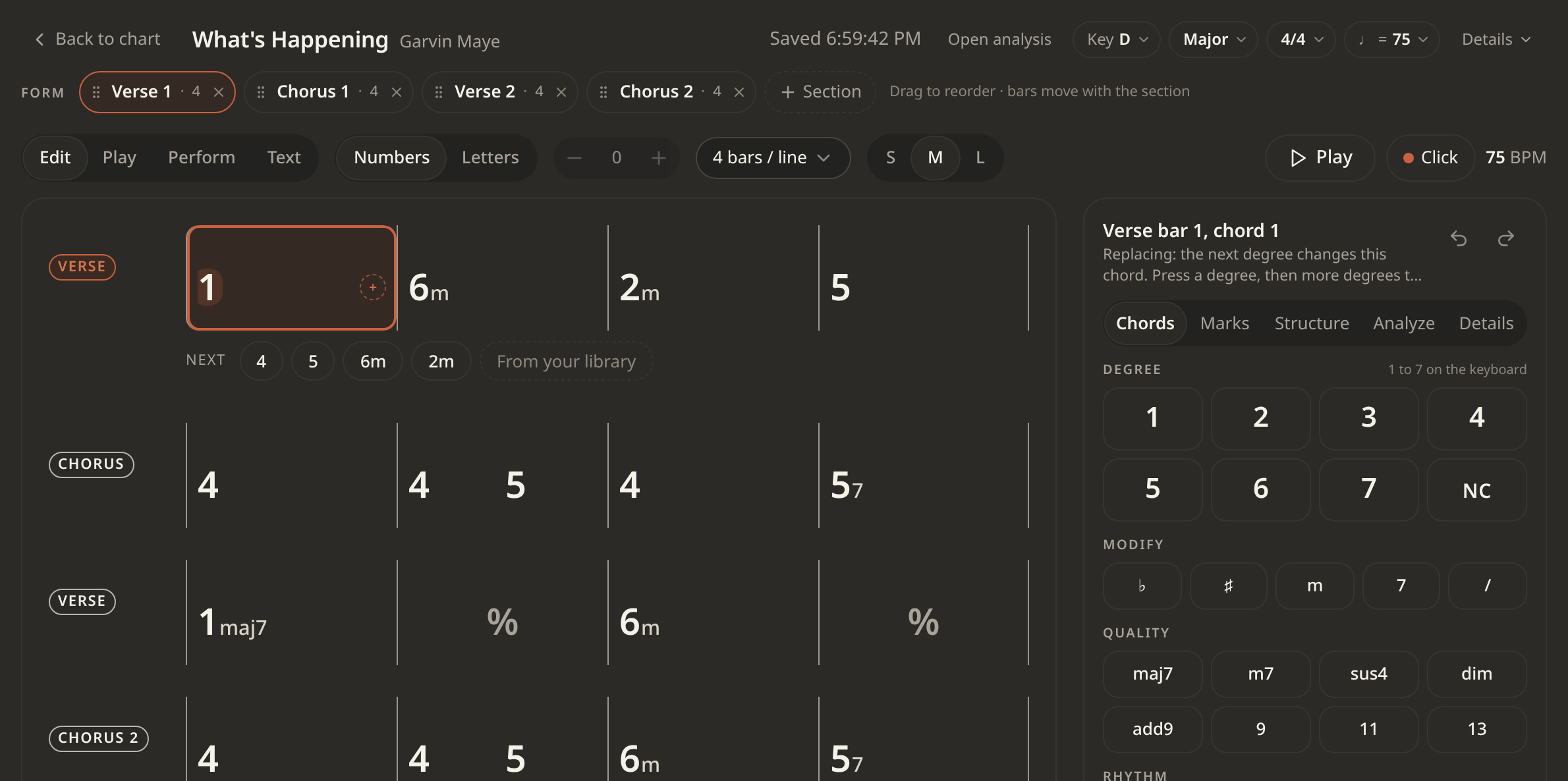
Chart the harmony.
Type 1, then 5, and both land in the bar. Mark the real rhythm: pushes, holds, stops, accents and ties. Playback hears the marks: pushes land early, ties ring into the next bar, doritos cut short and accents hit harder. Print a clean chart for the session, and save the phrases you love to Harmonies.
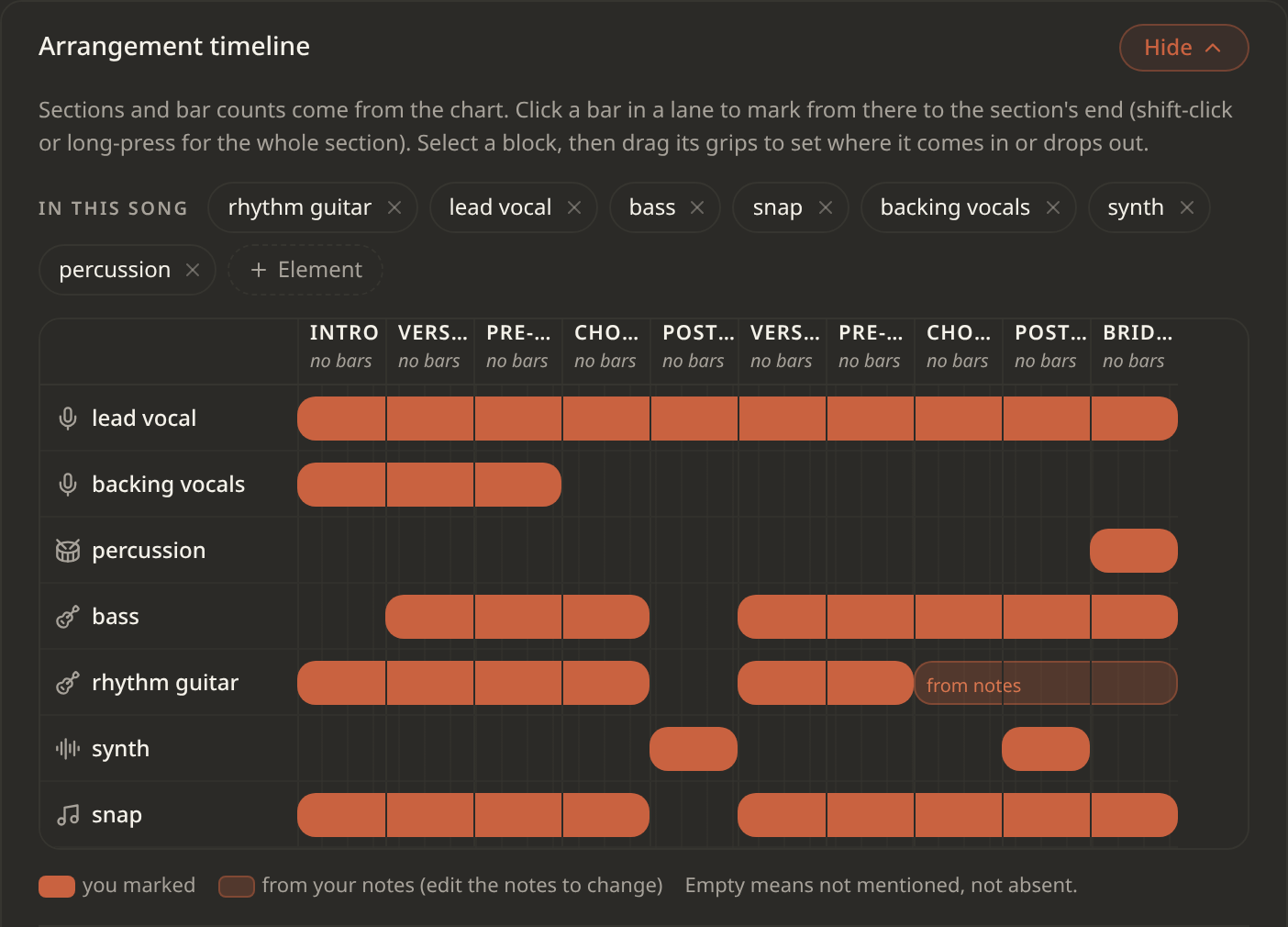
Click the arrangement.
Instruments down the side, sections across the top. Click what you hear, and see what drops out when the chorus hits. Then follow any part across all your songs: where it enters and what it comes in with.
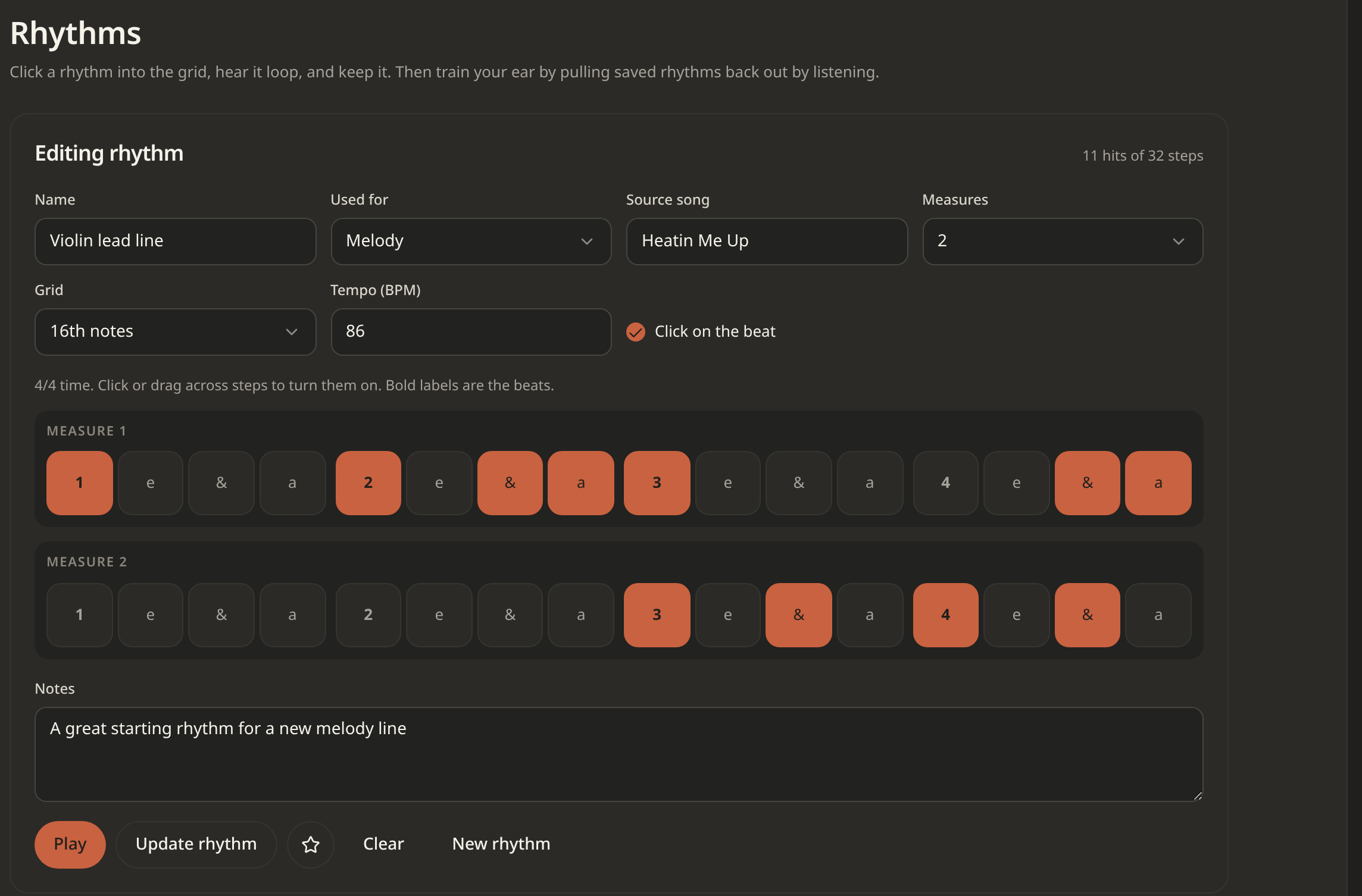
Capture the groove.
Click a rhythm from any part of a song into a grid and save it. Catch a vocal lick and use it later as a bass line, a strum or a piano part. Drill it by ear when you want to.
The Taste Loop™
Sound Patch runs on one loop. You capture what you hear, it reflects it back, your patterns pile up, and you reach for your next move.
Catch what moves you
Chart it, click it, or write it in your own words. A full breakdown, or a few notes when an idea hits away from the DAW. Sound Patch never listens to the song. You do.
Start capturingin your words. it never hears the song.
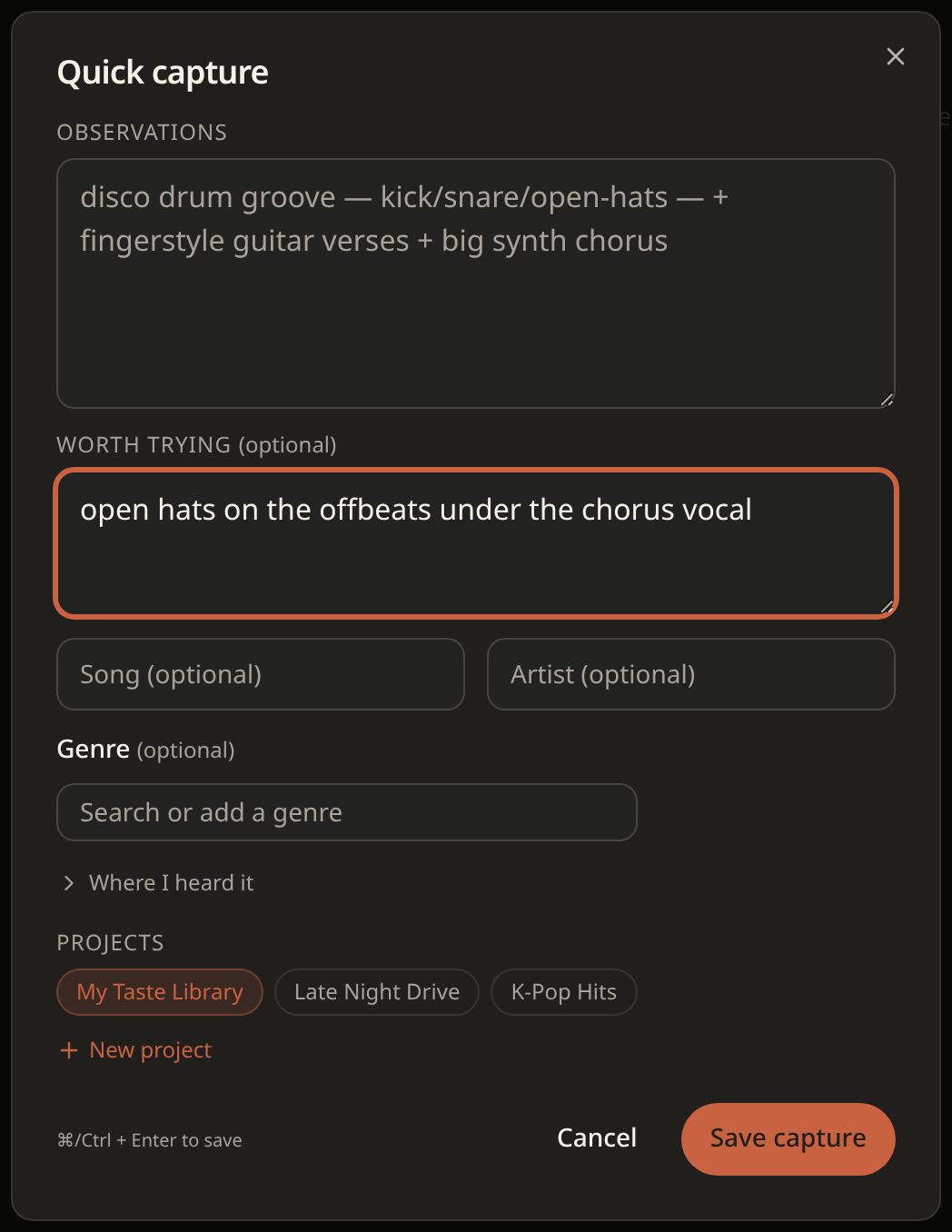
a few notes count.
Find out why it hit you
Every song you break down gets named back to you. A Taste Reflection shows what's doing the work, built only from your own notes and marks. A Pattern Flag names the move in words you can reuse with a co-writer, a client or an engineer.
See your patternswhy it hit you, named back.
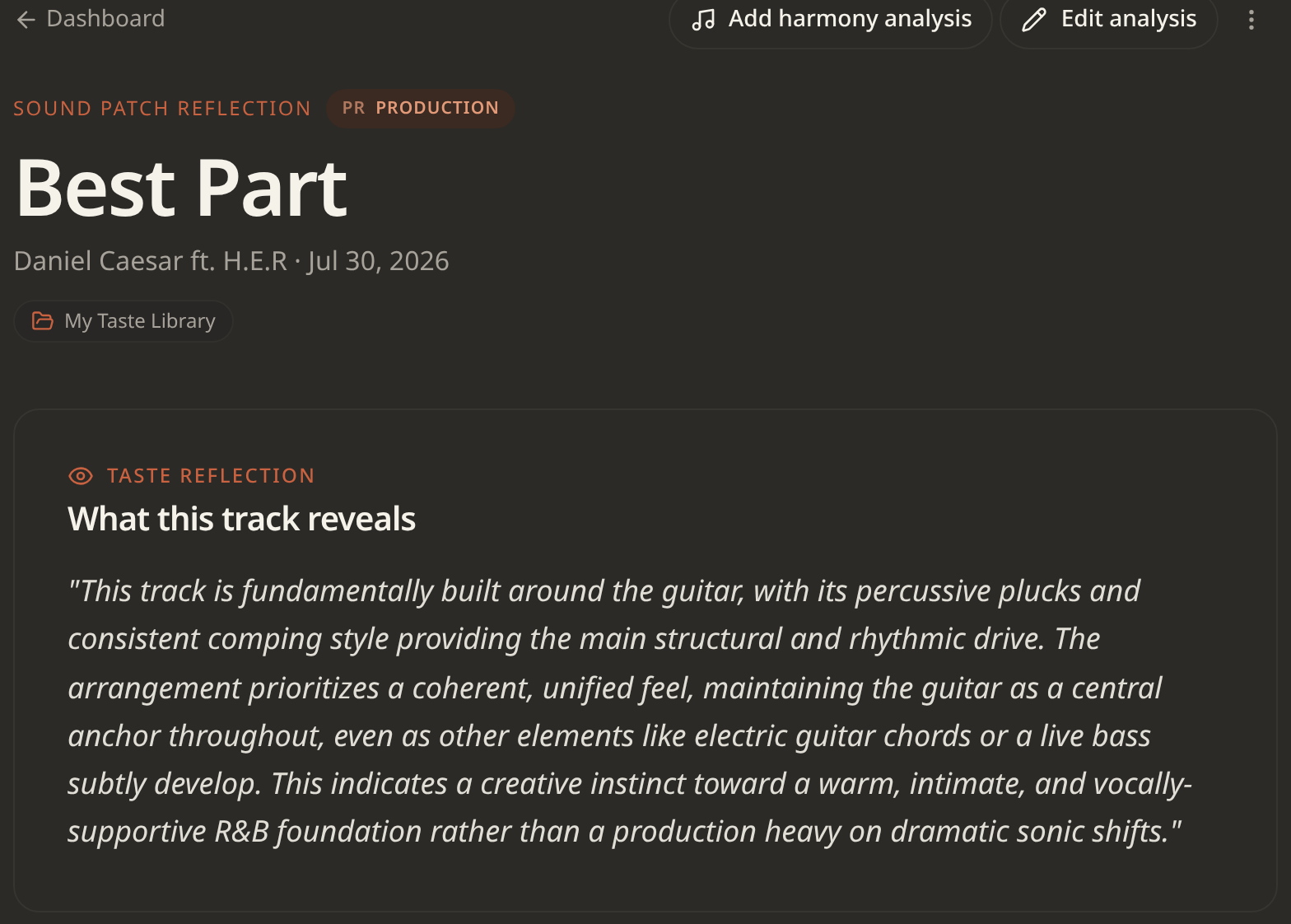
words you can reuse.
See what your songs share
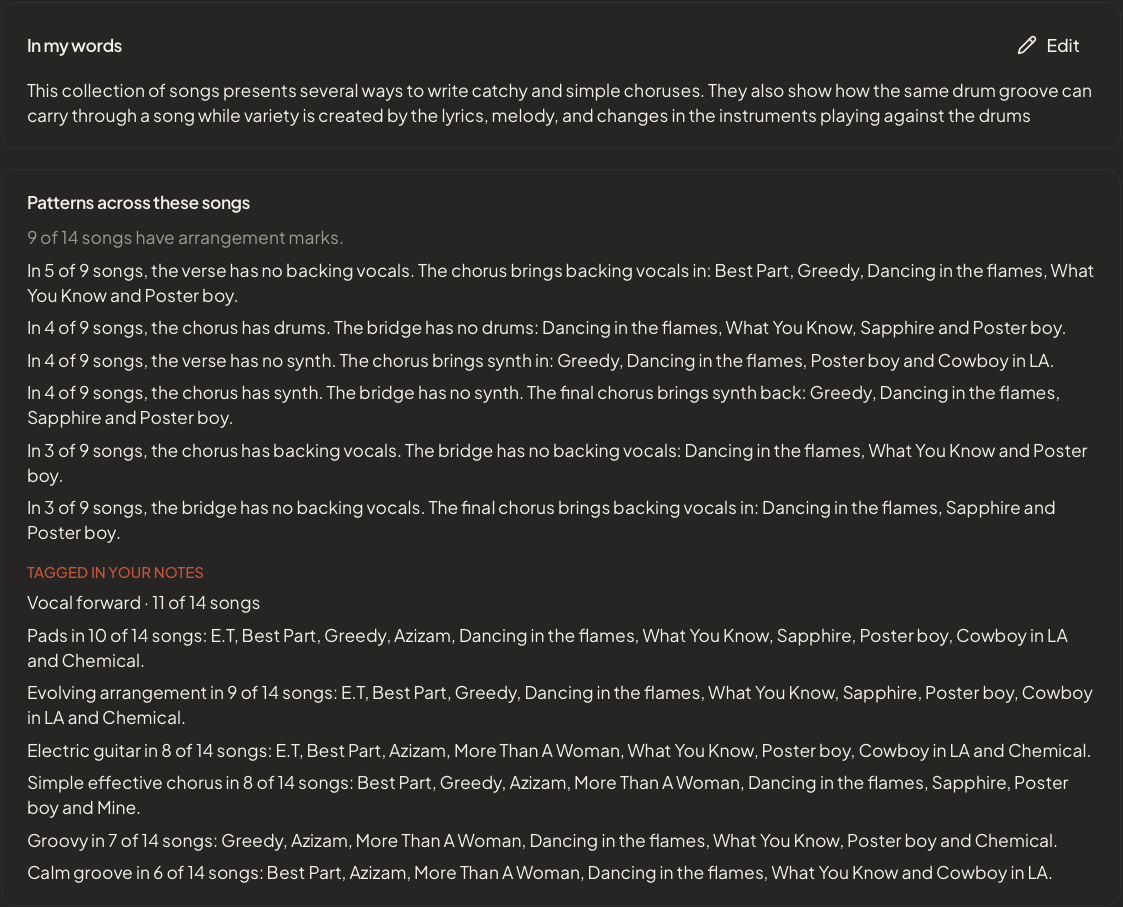
Once three songs share something, Patterns names it in plain words, with the songs behind it. 'In 5 of 9 songs, the verse has no backing vocals. The chorus brings them in.' Read it in plain sentences or dig into the numbers.
Build your librarynamed at three songs.
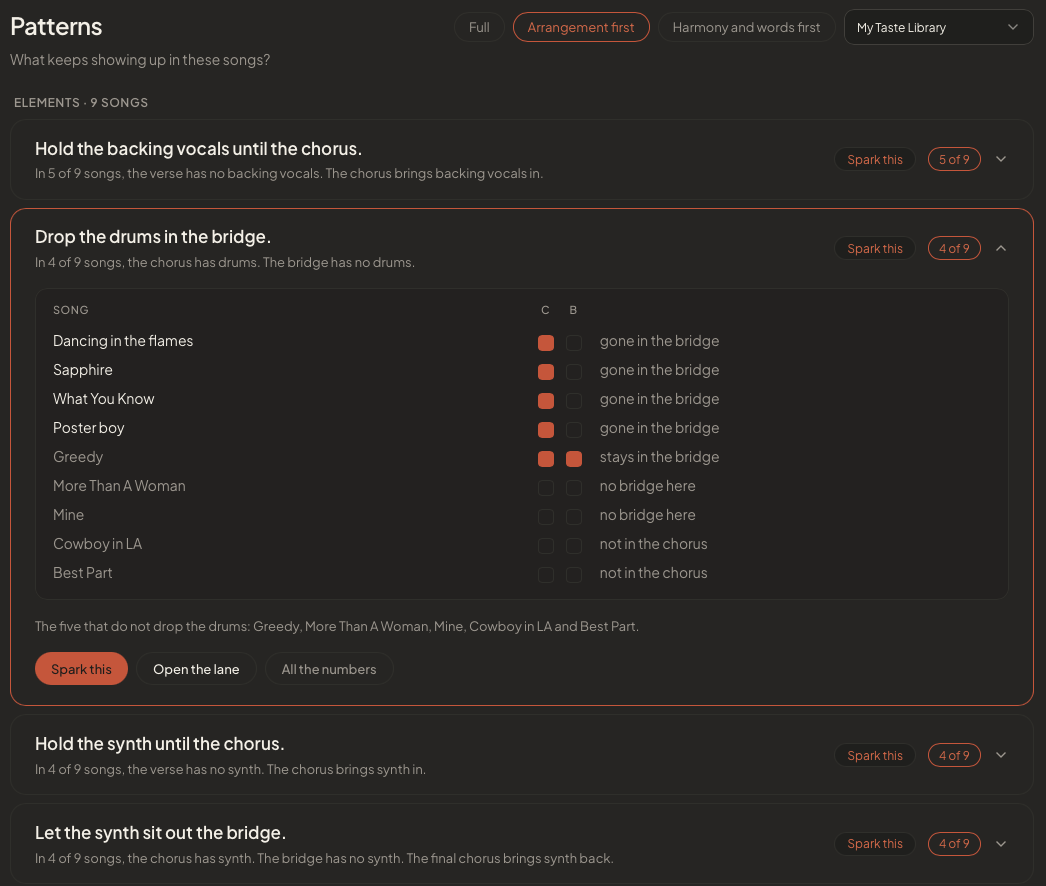
with the songs behind it.
Get your next move
Sparks asks one question: what could I try next? Pick where you're stuck, like the bridge or the bass, and get moves pulled from your songs. Each one shows the song and section it came from. Keep the good ones in the Brain.
Get your first movewhat could I try next?
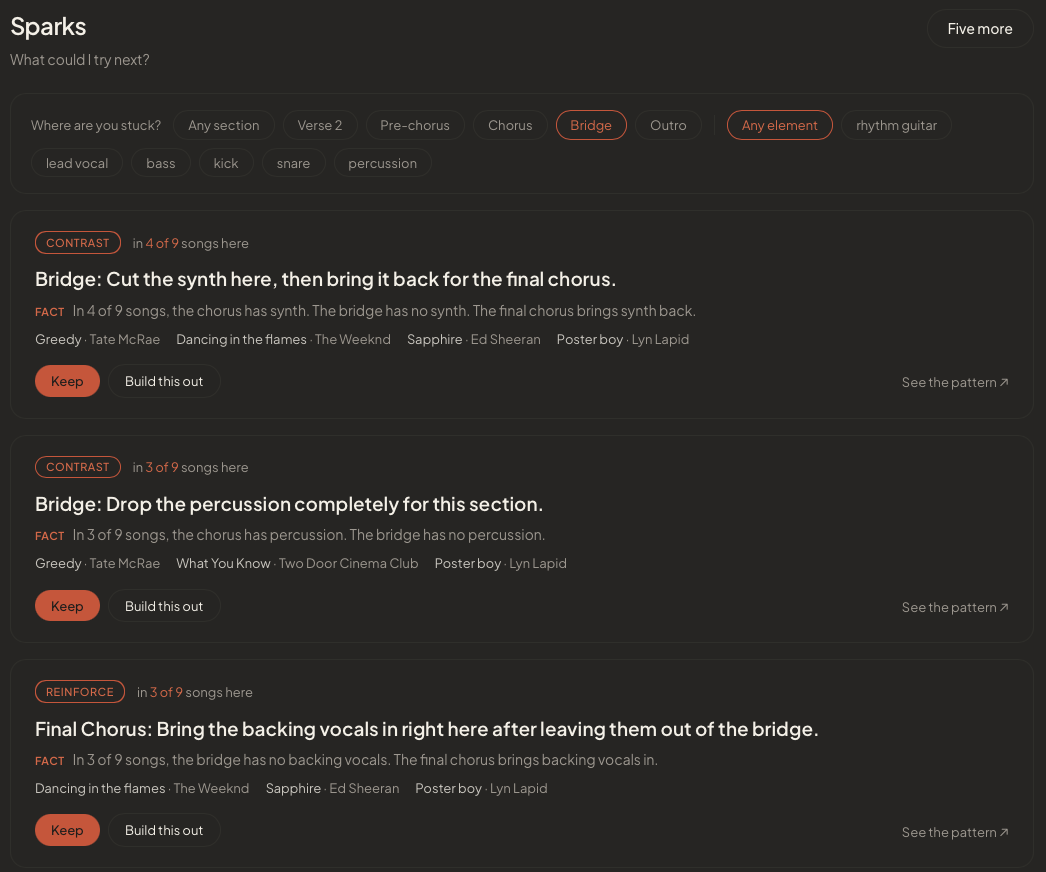
the songs it came from.
Turn your playlist into a brief.
An artist sends a producer a playlist and says, 'something like these.' You both hear the same songs and pull out different things. A brief puts you on the same page, with specifics.
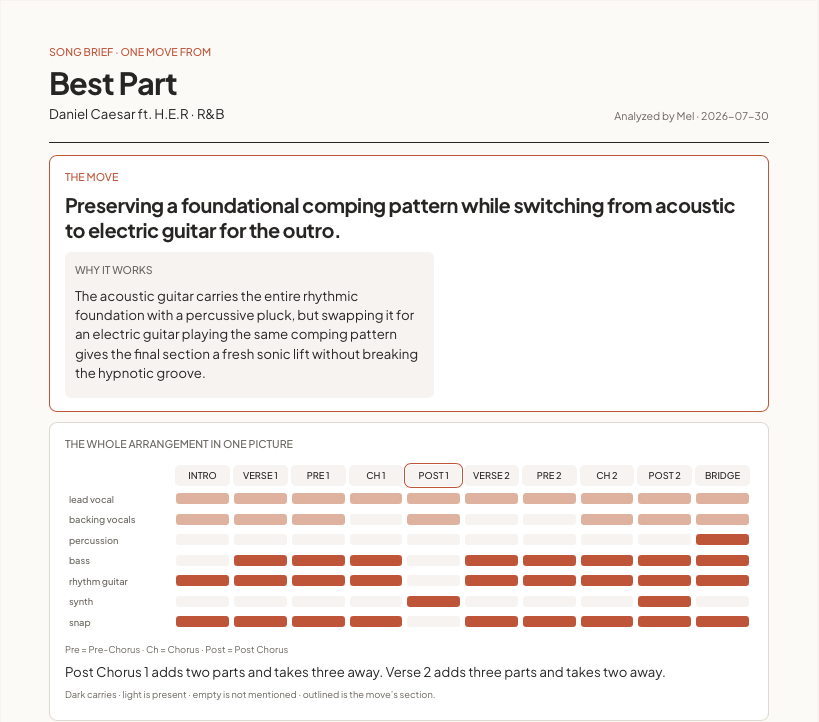
Song brief
One song on one page: the move that makes it work, the whole arrangement at a glance, and something to try in your own music.
Project brief
A whole project: the songs, your direction in your own words, patterns with counts and song names, arrangement habits, saved progressions and rhythms, and prompts for whoever gets it.
"In 5 of 9 songs, the verse has no backing vocals. The chorus brings backing vocals in: Best Part, Greedy, Dancing in the flames, What You Know and Poster boy."
Artist to producer, or producer to artist. Copy it or download a PDF.
Why building it works
Making beats reading.
What you build yourself sticks better than what you just watch or read.
Mix what moves you.
Try chords from one song, a rhythm from another, and an arrangement idea from a third. Your library gives you plenty to mix.
Pros chart by ear.
Songwriting and production programs have students chart songs by ear, because it trains how you hear.
Research: Slamecka & Graf (1978) on the generation effect; de Clercq (2019) on charting in music education.
Here's exactly what Sound Patch can and can't do.
Most AI music tools race to make the song for you. Sound Patch goes the other way. It helps you catch what you hear and use it yourself.
It never listens to anyone's music.
No uploads, no stem separation, nothing reading a waveform. I'm not training AI to make music. That's wack. I want to help you become a better music maker. You listen, you write down what you noticed, and Sound Patch works from your words. It isn't trained on anyone's music. It's trained on your ears.
Every line has proof.
Every pattern and every brief line traces back to songs you analyzed. The Taste Reflection uses only your own notes and marks, and names the songs behind every sentence. You get 'electric guitar in 8 of 14 songs,' with the songs to check.
It gets better with every song you add.
One song gets you a reflection. A pattern is only named once three songs show it. The more you add, and the more specific your notes, the more the moves sound like you.
It won't tell you about your own tracks.
It only ever sees the records you studied. It can show you what keeps pulling you in. It can't tell you what you do.
The hearing is still yours.
Use it your way.
Get clear on your sound.
Or help a client get clear on theirs.
Gather ideas.
For your next song, EP, or album.
Study an artist, a producer, an era, or the charts.
Log the songs in a project, see the patterns they share, and add them to your bag.
Show up to the session ready.
Hand your artist or co-writer a brief with the patterns you're chasing, and bring pitch ideas with proof behind them.
From one song nerd to another
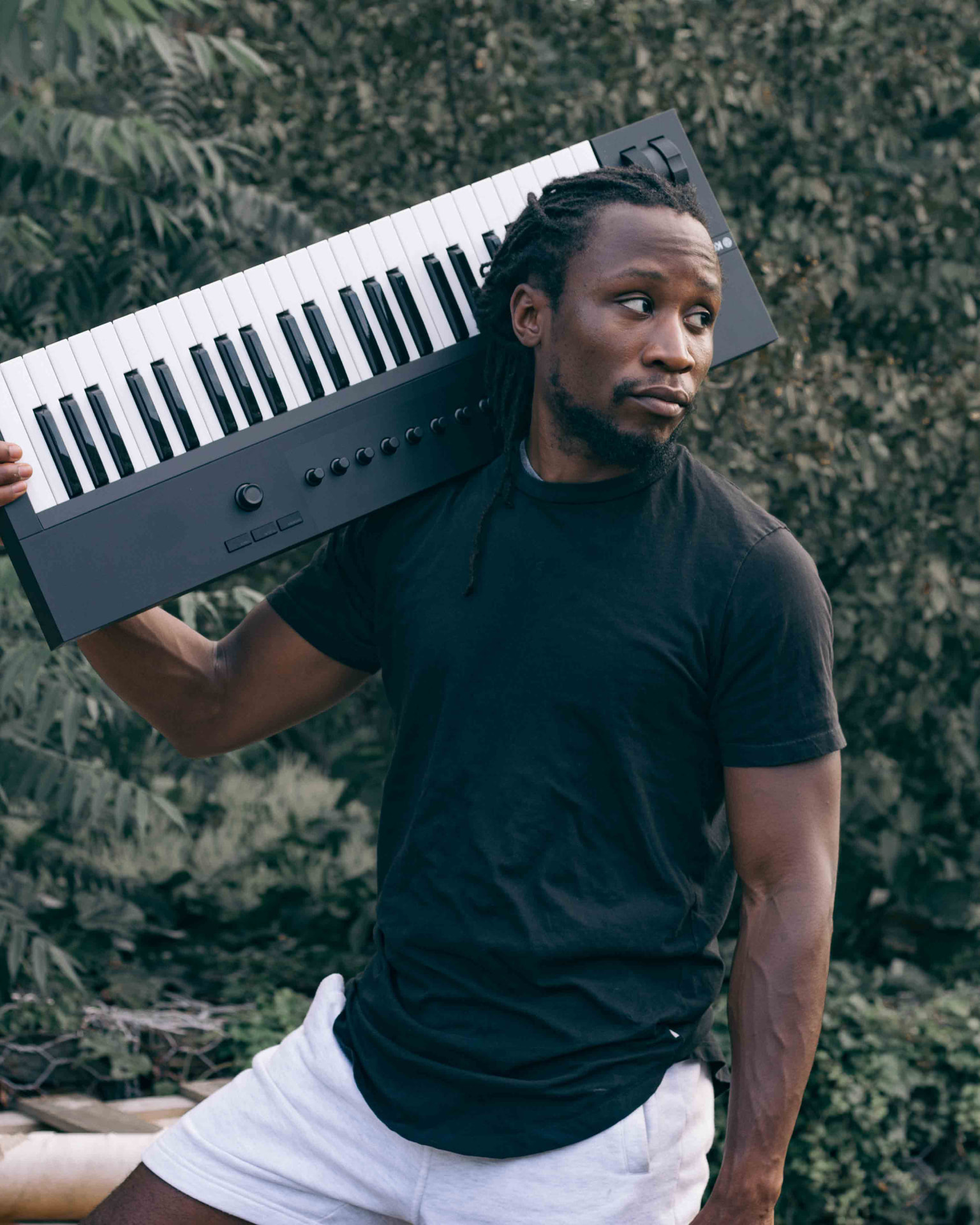
"Athletes study film. Musicians study songs. I spent years doing it with books, chord charts and a pile of apps, so I built one place to break down the songs I love, keep the parts that move me, and turn them into moves I can use."
Melvin Darrell
Music Producer and Founder of Sound Patch
The more pro decisions you see, the more you'll reach for them. That takes reps.
Every time you use it, you get better at three things.
Deep listening.
Hearing what's doing the work in a song.
Pattern recognition.
Spotting the moves that keep coming back.
Taste.
Knowing what you love and why, so you can make more of it.
Get founding access
Founding pricing is open to the first 50 members.
$99/year
This is the founding price. It goes up after founding membership closes.
Not feeling it? Full refund. Try it for 14 days. Log a few songs you love. If the moves don't feel useful, email me for a full refund. No hoops.
Monthly plans stop whenever you like.
Questions,
answered.
A tool that turns your notes on the songs you love into patterns, moves to try, and briefs you can hand to a collaborator.